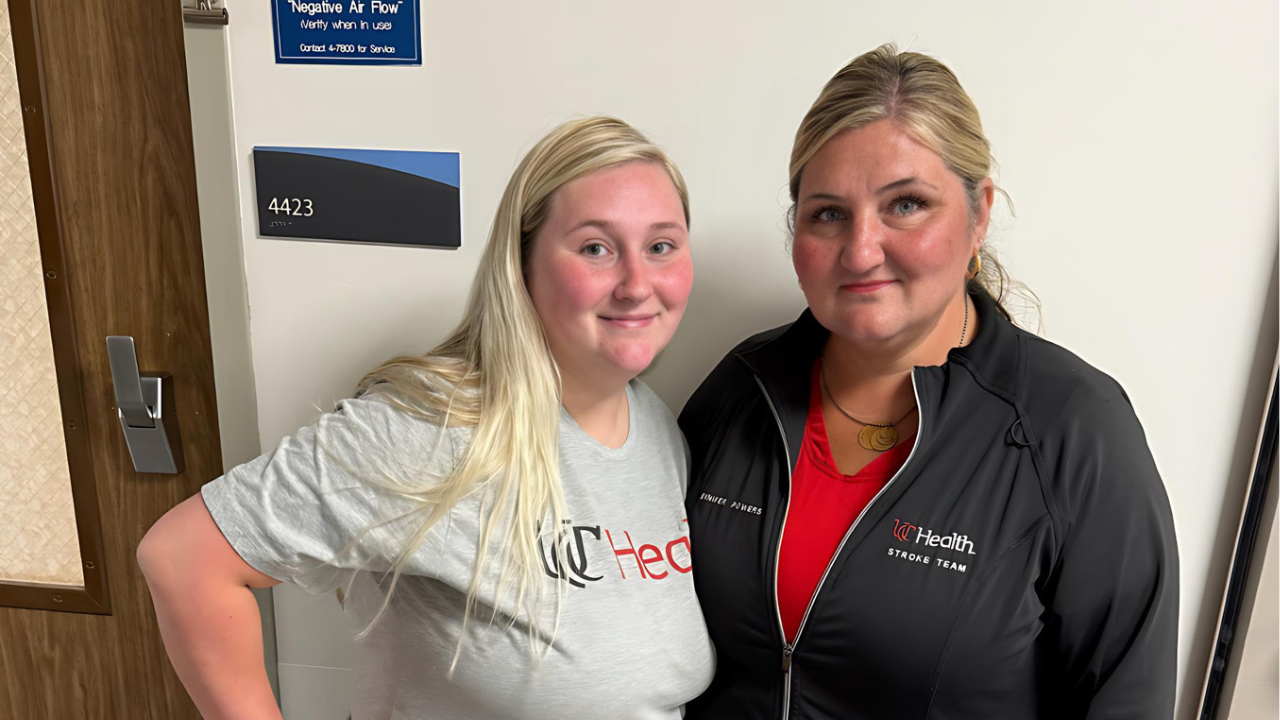
Jennifer Powers, a member of the stroke clinical research team, and her daughter, Sarah, a patient care assistant on the Neuroscience Acute Care Unit, are carving parallel paths in neurology—one focused on advancing discoveries, the other helping stroke patients feel at ease.
Jen’s Journey: From Personal Loss to Professional Purpose
Jen’s path to neurology research is deeply personal. Having lost her grandmother to a massive stroke and her mother to a sudden heart attack at only 43, she carries those experiences with her every day.
She began her career in neurology nearly two decades ago, working alongside expert UC Health neurologists, like Dr. Daniel Kanter, who mentored her in stroke care. Over the years, her role evolved from medical assistant to clinical research, where she now educates patients and families about trials that may shape the future of treatment.
“Before I started working in research, I thought it meant being a guinea pig,” Jen admitted. “But you don't think about all the things that have come from research.”
Those breakthroughs include treatments like tPA (tissue plasminogen activator), a medication that can dissolve blood clots before they cause major damage, and thrombectomy, a procedure where a catheter is guided to the brain to remove a clot. Decades ago, these options didn’t exist. Today, thanks to research, they save lives.
“My grandmother wouldn't have had a massive stroke. Maybe they could have gotten that clot, and she could have lived—not been in a coma for years before she passed away,” Jen reflects.
Sarah’s Inspiration: Following in Her Mother’s Footsteps
Growing up, Sarah was surrounded by her mom’s stories of stroke patients and her work on the neurology floor. Those stories stuck with her.
“I’ve wanted to be a nurse probably since I was sixteen,” Sarah says. Hearing about neurology and how passionate her mom definitely inspired her to enroll in nursing school.
Now a nursing student, Sarah works as a patient care assistant on the Neuroscience acute care unit. While she admits she’s naturally more reserved than her mom, Sarah approaches patients with empathy to ease their fears.
“I try to talk to patients how I’d want someone to talk to me,” she explained. “I always introduce myself and just try to make them feel less scared.”
Research and Care Working Hand-in-Hand
Although Jen and Sarah work in different areas of UCGNI, their worlds often intersect. Sarah has assisted on clinical studies, sometimes introducing her mom to patients who might be eligible.
By taking time to connect with patients and explain how clinical trials work, Sarah believes she helps them feel more comfortable about participating.
For Jen, watching her daughter embrace her work is both inspiring and emotional.
“All the physicians love her. All the patients love her. She gets a lot of shout-outs in the hospital, which makes me proud,” Jen says.
Showing Compassion in Their Work
For both mom and daughter, it all comes down to kindness. “The only advice I’ve ever given Sarah is to always treat people the way you want to be treated,” Jen says. “Just be compassionate.”
Their story is a powerful reflection of UC Health’s dedication to improving lives through groundbreaking research and compassionate care.
At the UC Gardner Neuroscience Institute, compassionate care meets breakthrough research—so you feel supported today while we work toward better treatments for tomorrow. If you’re exploring stroke care or wondering about clinical trials, connect with our team to talk through options that fit your goals. Call us directly at 866-941-8264.